A team has found a burial near the town of Atalanti, in east-central Greece. The Greek Ministry of Culture announced it. The cemetery was found during building work. It lies about 60 miles northwest of Athens.
The burial is of a woman from the seventh century BC. The team calls her the Lady with the Inverted Diadem. She died between the ages of 20 and 30. Her bronze diadem was placed upside down. The article also calls this diadem a crown.
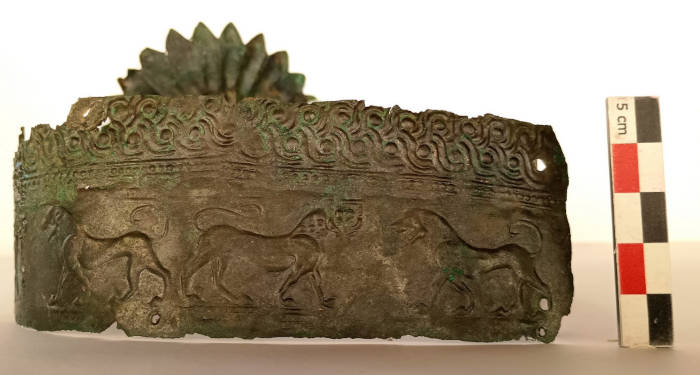
The crown has a large rosette on the front. On the back, pairs of male and female lions face each other. They are embossed. Because the crown was upside down, the lions look as if they are lying down. The article says lions had long stood for royal power in Greek culture. It points to the Lion Gate at Mycenae, in the 13th century BC, as a sign of a king's power.
The article says the upside-down crown appears to show a ruler stepping down, or falling from power. The ministry says she may have lost her high position in the mid-seventh century BC. That is a reading. The dig shows the crown. It does not show the political act.
The grave held other goods. These include buckles and a bronze pin with horses in a geometric style. There is a bronze necklace with a vase-shaped amulet. There were also bone and ivory beads, copper earrings, a bracelet, and spiral rings. The article says these goods speak to her high status.
About 40 graves are at the site. They belong to people of high social status. They date from 800 to 323 BC. The article calls those years the Archaic and Classical periods.
A child of four was buried close by. The child was buried with a bronze diadem with small rosettes. It dates to the same time.
Maria Papageorgiou leads the dig. She is of the Ephorate of Antiquities of Phthiotis and Evrytania. Work is still going on. The team hopes to find more graves. They have also found traces of a fortified settlement beside the cemetery.
What was found: the burial of a woman aged 20 to 30. Her bronze diadem was placed upside down. Other goods were with her. The cemetery has about 40 graves. A child of four was buried nearby, with a bronze diadem. Traces of a fortified settlement were found too. Where: near Atalanti, about 60 miles northwest of Athens. When: the woman is dated to the seventh century BC. The graves run from 800 to 323 BC. The article is dated 8 December 2025. It does not give the day of the dig.
From an Ancient Origins article by Gary Manners, 8 December 2025.
The Greek Ministry of Culture has announced a find from east-central Greece. During building work near the modern town of Atalanti, an ancient cemetery was found. It lies about 60 miles (96 kilometres) north-west of Athens. Ancient Origins reported it on 8 December 2025. Known.
The cemetery holds about 40 graves. They belong to people of high social status who died during the Archaic and Classical periods, between 800 and 323 BC. The dig is led by Maria Papageorgiou of the Ephorate of Antiquities of Phthiotis and Evrytania, the local archaeology service. Beside the cemetery, the team has also found traces of a fortified settlement. Known.
One grave stood out. It belonged to a woman from the seventh century BC, who died between the ages of 20 and 30. The team calls her "The Lady with the Inverted Diadem". A diadem is a crown or headband. Hers was made of bronze. It has a large rosette, a flower-like design, on the front. On the back, pairs of male and female lions face each other, embossed so they stand out from the metal. The diadem was placed upside down on her head when she was buried. Because of this, the lions appear to be lying down. Known.
Her grave held other goods too: buckles, a bronze pin decorated with horses in a geometric style, a bronze necklace with a vase-shaped amulet, bone and ivory beads, copper earrings, a bracelet, and spiral rings on each of her fingers. The report says these goods speak to her high status. Known.
Close to the woman, archaeologists found the burial of a child of four. The child wore a bronze diadem decorated with small rosettes. The child's grave dates to the same time as the woman's. The report says this suggests a possible family link. Known for the grave and the diadem. The family link is a "possible".
Why might a crown be put on upside down? The report explains that lions had long stood for royal power in Greek culture. It points to the famous Lion Gate at Mycenae, which showed the power of the king in the 13th century BC. So lions lying down might send a message. Known as the background the report gives.
The report also sets the grave in its time. The ministry says the woman may have lost her privileged position during a period of strong social and political upheaval in the mid-seventh century BC. The report says this troubled age was later settled by the reforms of Solon, an Athenian lawmaker it calls legendary. His reforms, in the early sixth century BC, laid the foundation for Athenian democracy. Solon is not named in the grave. He is part of the history of the age. Known as the history the report gives.
Did the upside-down crown really mark the end of her power? The headline calls her a "fallen noblewoman", and the report says the crown "appears to" mark the end of her power. Other reports are just as careful. Archaeology Magazine, published by the Archaeological Institute of America, said on 5 December 2025 that the crown was placed upside down "perhaps to mark the end of her reign through resignation or removal". Live Science, on 2 December 2025, said it "may have signified a final end to her power". Both base their reports on the ministry's statement. No independent expert who agrees or disagrees was found. So the crown's position is Known, but what it meant is Debated. The report does not say how the woman's age at death or the date of the grave were worked out. Debated.
Sources: - Archaeology Magazine (Archaeological Institute of America), "2,700-Year-Old Noblewoman's Burial Excavated in Greece", 5 December 2025. https://archaeology.org/news/2025/12/05/2700-year-old-noblewomans-burial-excavated-in-greece/ - Kristina Killgrove, "Elaborate 2,700-year-old tomb in Greece contains burial of a woman with an upside-down crown", Live Science, 2 December 2025. https://www.livescience.com/archaeology/elaborate-2-700-year-old-tomb-in-greece-contains-burial-of-a-woman-with-an-upside-down-crown
Sources:
https://www.ancient-origins.net/news-history-archaeology/greek-burial-tomb-atalanti-00102367