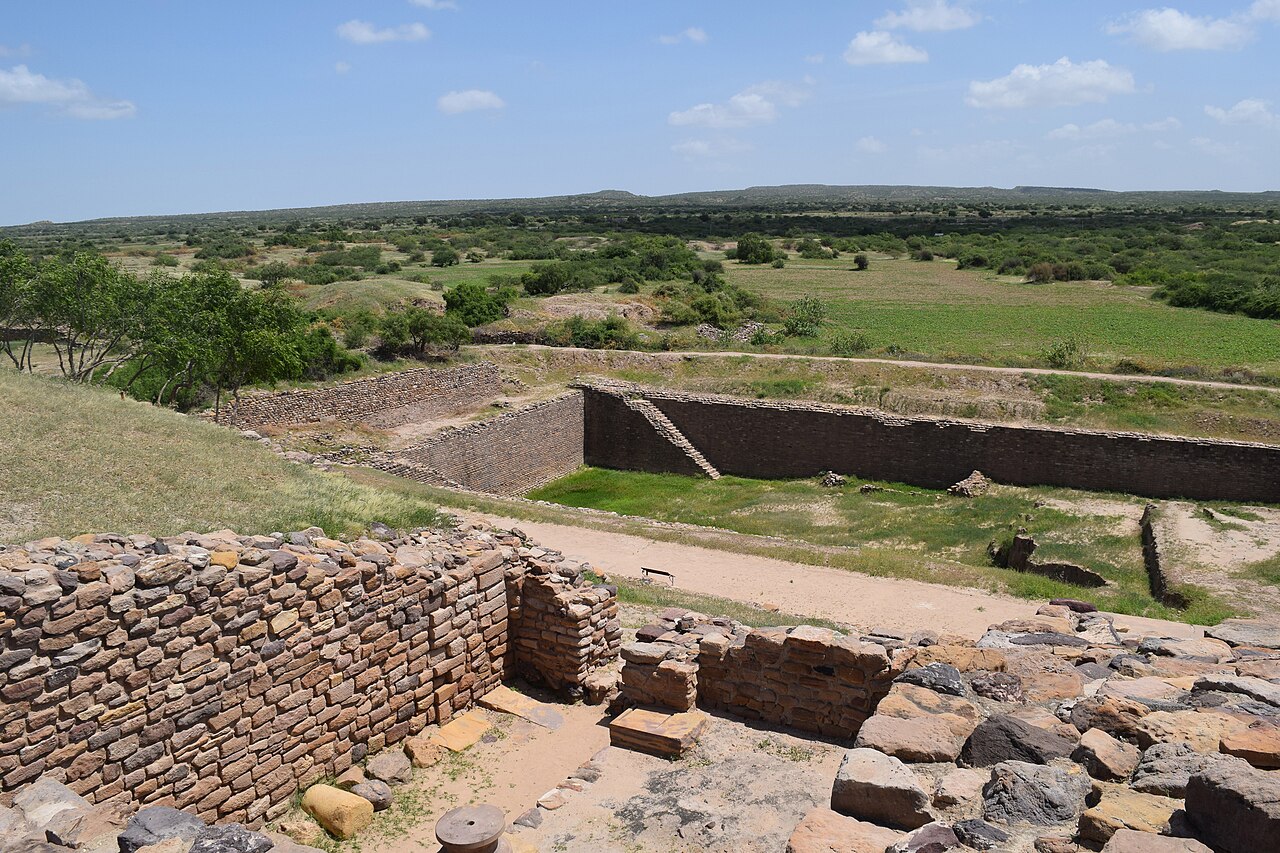
A stepwell has been reported at Dholavira. The page says Dholavira is one of the largest cities of the Indus Valley. The page says the stepwell is 5,000 years old. The page says it is said to be three times bigger than the Great Bath at Mohenjo Daro.
The Times of India, as the page quotes it, calls this the largest, grandest, and best furnished ancient reservoir discovered so far in the country.
The Archaeological Survey of India plans to study the find. So does IIT-Gandhinagar. They plan to study water flow patterns and ancient water conservation. They also plan to study evidence of manufacturing. That evidence is the beads and semi-precious stones found at the site.
The page gives a size from inSerbia News. The stepwell is 73.4 m long, 29.3 m wide, and 10 m deep. That is 240 ft, by 96 ft, by 32.8 ft. The Great Bath was uncovered in 1926. It is 12 m long, 7 m wide, and 2.4 m deep. That is 39.3 ft, by 22.9 ft, by 7.8 ft. The page says the Great Bath is part of Mohenjo Daro, a Bronze Age metropolis. Digs there found 40,000 artefacts.
The page says stepwells are ponds or wells with stairs descending into them. They were used for water conservation and access. Some were used as monuments. Some have elaborate carved images.
The page says this find is described as similar to the Queen’s Stepwell. That is Rani-ki-Vav. It was added to the UNESCO World Heritage List in 2014.
Scroll.in says the site is a well, but should not qualify as a stepwell. Scroll.in says it should be called a reservoir. It does agree that the well is larger than the Great Bath.
The writer’s reply on the page adds a note. Researchers quoted by Scroll.in suggest archaeologists knew of the surrounding reservoir 15 years earlier. Researchers quoted by The Times of India seem to have newly identified the stepwell inside it. The page says no source mentions water in it. The photo does not show the bottom.
The page says the Indus Valley civilisation, also called the Harappan era, was among the earliest known cultures of the Old World. It dates that era from about 3300 to 1900 BCE. Citing a note, the page says the major centres were known for urban planning and baked brick houses. They were known for elaborate drainage systems and water supply systems. They were also known for clusters of large non-residential buildings. The page names Dholavira and Mohenjo Daro among them.
What was found: a stepwell reported at Dholavira, plus beads and semi-precious stones at the site. Where: Dholavira, one of the largest cities of the Indus Valley. When: the page says the stepwell is 5,000 years old. The page does not give the day it was found. The article date is 5 November 2014.
From an Ancient Origins article by Liz Leafloor, 5 November 2014.
Dholavira is one of the largest cities of the Indus Valley Civilisation, in what is now India. That civilisation is also called the Harappan era. Ancient Origins dates it from about 3300 to 1900 BC and calls it one of the earliest known cultures of the Old World. Its major cities, including Dholavira and Mohenjo Daro, were known for town planning, baked brick houses, drainage systems, water supply systems, and clusters of large buildings that were not homes. Known as the history the report gives.
On 5 November 2014, Ancient Origins reported that an ancient stepwell had been found at Dholavira. A stepwell is a pond or well with stairs going down into it. The report says stepwells were used to store water and reach it, and some were built as monuments, decorated with carvings. It said the new find was 5,000 years old. It quoted The Times of India calling it the "largest, grandest, and the best furnished ancient reservoir discovered so far in the country". Known as what the report says.
The report gives the stepwell's size from a news site called inSerbia News. It is 73.4 metres (240 ft) long, 29.3 metres (96 ft) wide and 10 metres (32.8 ft) deep. It compares this with the Great Bath at Mohenjo Daro, a famous Bronze Age pool found in 1926. The Great Bath is 12 metres (39.3 ft) long, 7 metres (22.9 ft) wide and 2.4 metres (7.8 ft) deep. Digs at Mohenjo Daro have found 40,000 artefacts. The new find was also described as similar to the Queen's Stepwell, or Rani-ki-Vav, which joined UNESCO's World Heritage List in 2014. Known as the report gives it.
The Archaeological Survey of India and the Indian Institute of Technology at Gandhinagar planned to study the find. They wanted to look at how water flowed, how people saved water long ago, and what the beads and semi-precious stones found at the site reveal about making things there. Known.
Was it really a new stepwell? The report itself says some people were sceptical. It names Scroll.in, an Indian news site, which said the structure was a well but should not count as a stepwell. Scroll.in called it a reservoir, a large tank for storing water. Below the report, the writer added a reply to a reader. She said researchers quoted by Scroll.in thought archaeologists had known about the surrounding reservoir 15 years earlier. The team quoted by The Times of India seemed to have newly identified a stepwell inside it. She also noted that the photo does not show the bottom, and no source mentions water in it. Known as what the report and its reply say.
Scroll.in's own article, by Mridula Chari, was published on 10 October 2014. It quotes VN Prabhakar, the supervising archaeologist at Dholavira. He said, "The discovery was made almost 15 years back," by RS Bisht, who was then the curator of Dholavira. It also quotes Vilas Jadhav, an engineer with the Archaeological Survey of India. He said, "A stepwell is a very specific thing," and that some village wells have steps but are not called stepwells. Jadhav said the newspaper had mistaken the city's eastern reservoir, which has a rock-cut well with steps inside it. Prabhakar said the reservoirs were made "around 2500 BC", which is about 4,500 years ago, not 5,000. Debated.
There is one more puzzle, inside Scroll.in itself. Prabhakar said the structure "is not even larger than the Great Bath". But Jadhav, in the same article, said the reservoir "is indeed larger than the Great Bath". So even the experts who doubted the stepwell did not agree on its size. The lengths in the report are 73.4 metres for the Dholavira structure and 12 metres for the Great Bath. The record does not say who measured them or what exactly was measured. Debated.
So what do we know? A large water structure at Dholavira was reported in 2014. Experts at the site said it was a reservoir, known for about 15 years, with a well with steps inside. Whether it was a stepwell, how old it is and how big it is compared with the Great Bath are Debated.
Sources: - Mridula Chari, "Claim that largest Harappan stepwell has been found in Gujarat baffles archaeologists", Scroll.in, 10 October 2014. https://scroll.in/article/683009/claim-that-largest-harappan-stepwell-has-been-found-in-gujarat-baffles-archaeologists
Sources:
https://www.ancient-origins.net/news-history-archaeology/5000-year-old-stepwell-found-dholavira-said-be-largest-india-002291
.jpg)