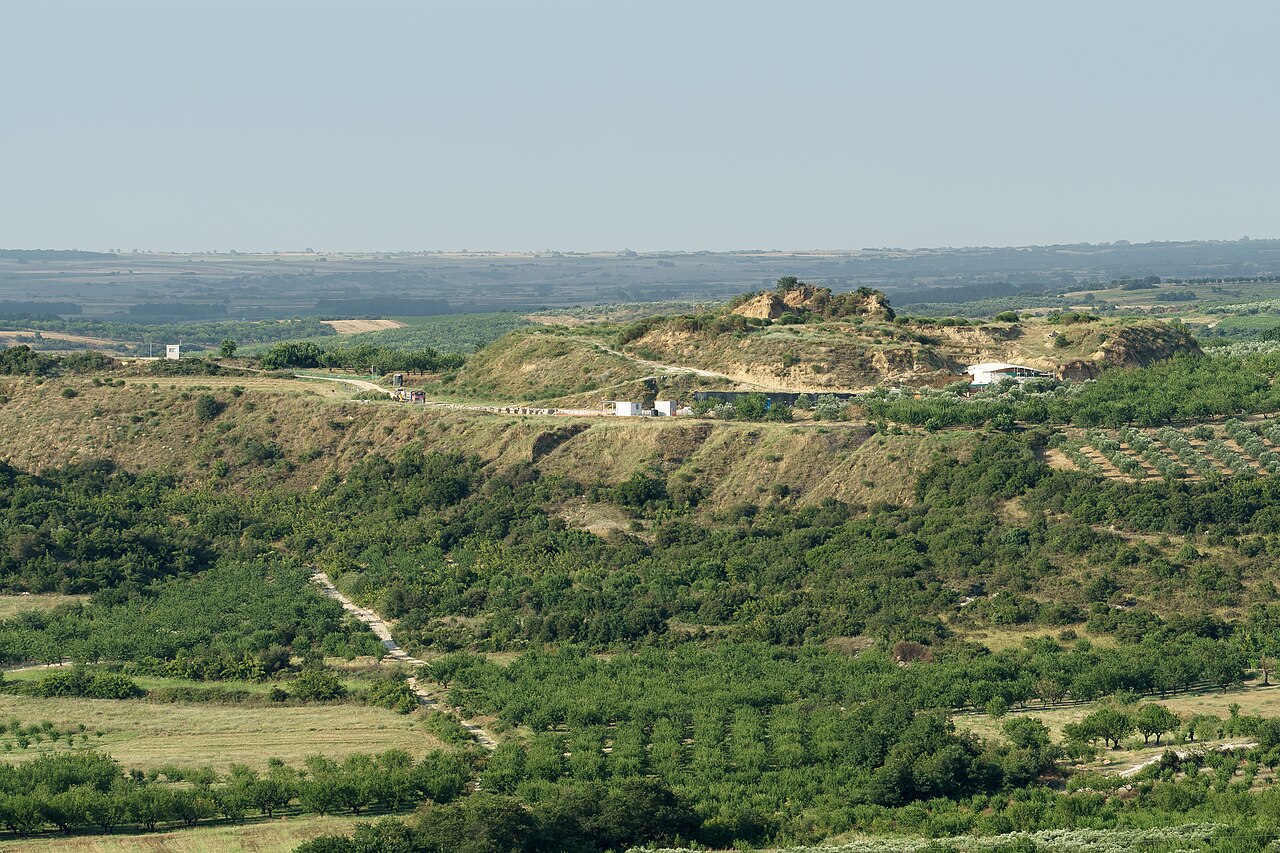
A huge burial mound in northern Greece can now be seen as a whole. It is the Kasta Tomb at Amphipolis. This is the first time the full tomb has been visible since the site was uncovered. The work is a dig and a restoration. It is still going on.
Lina Mendoni visited the site. She is the Greek Culture Minister. Teams have uncovered the whole marble peribolos. The article says a peribolos is the enclosure wall. The wall runs 497 metres around the mound. It encloses more than 20 acres. The wider site covers over 50 acres. The Ministry of Culture runs that wider site. The mound is more than 140 metres across. That is bigger than the Great Tumulus at Aigai, which is around 110 metres. Mendoni said this is the largest burial mound found so far in Macedonia. She called it a unique and magnificent Macedonian monument.
On the south side, 105 metres of the wall have been rebuilt. The blocks are original marble from the dig. Conservators added only a little artificial stone, where the wall needed more support. Work now is on making the west side stable. Crews are putting in a hydraulic drainage network. It will guard the mound from rain and from long-term erosion. Engineers are reshaping parts of the hill, to bring back the first shape. Centuries of weather had changed that shape. Later interference had changed it too.
Inside, temporary steel supports have been taken out. So has the scaffolding. The inner rooms can be seen again, for the first time in years. The stone vault over the burial room has been repaired. Next, the team will put back the double marble door that once sealed the room. They will also restore the sphinxes at the entrance. Missing wings will go back, and the missing head of one sculpture.
The project is also finding traces of later activity. The team found signs of Roman dismantling. They found the spot where a crane once stood. It was used to take marble blocks away for reuse. Nearby are remains of ramps and lifting systems. The article says this was organised work to strip parts of the wall. It happened centuries after the tomb was built.
Scientific evidence dates the building to the last quarter of the 4th century BC. That was in the decades after Alexander the Great died in 323 BC. The marble points to a rich burial. So do the scale of the work and the design. The article ties that burial to the highest levels of the Macedonian elite. The team still does not know who was buried there.
An early idea was that the tomb was for Alexander himself. His body was later taken to Alexandria by Ptolemy I Soter. Most archaeologists have dismissed that idea. Many think it was more likely for someone close to him, in his circle or his family. Some experts have said it is like the work of Dinocrates of Rhodes. The article says he was an architect linked to Alexander's building projects. No one knows who was buried there.
Amphipolis had a key role in Alexander's campaigns. It was a naval base for expeditions into Asia. It was also a staging point for military operations in Thrace.
The cost is expected to pass 15 million euros. Support comes from regional and European funding programmes. There will be visitor facilities and a museum space on the east side. The aim is to reopen the tomb to the public in early 2028.
On the same visit, Mendoni saw the only wooden bridge still left from ancient Amphipolis. It dates from the 5th century BC. The historian Thucydides mentioned it. Work to conserve the bridge is now complete.
What was found: the full marble wall of the Kasta Tomb. The mound is more than 140 metres across. The inner rooms can be seen again. The vault is repaired. There are signs of later Roman stone removal. Where: Amphipolis, in northern Greece. When: the article is dated 13 May 2026. It does not give a single day for the dig. The tomb dates to the last quarter of the 4th century BC. A public opening is planned for early 2028. The bridge dates from the 5th century BC.
From an Ancient Origins article by Gary Manners, 13 May 2026.
For the first time since archaeologists uncovered it, the whole Kasta Tomb can be seen. It stands at Amphipolis, in northern Greece. Ancient Origins reported this on 13 May 2026. The dig and restoration are still going on. Greek Culture Minister Lina Mendoni visited to inspect the work. Known.
Teams have fully uncovered the marble peribolos. That is the enclosure wall around the mound. It runs for 497 metres and encloses more than 20 acres. The wider site, run by the Ministry of Culture, covers over 50 acres. The mound is more than 140 metres across. That makes it larger than the famous Great Tumulus at Aigai, which is around 110 metres. Mendoni called Kasta "a unique and magnificent Macedonian monument". She said it is the largest burial mound found so far in Macedonia. Known.
A Ministry of Culture press release says 105 metres of the southern wall have been rebuilt. The builders used original marble blocks found in the dig. They added only a little artificial stone where the wall needed extra support. Work is now on the western side. Crews are laying drains to protect the mound from rain and erosion. Engineers are reshaping parts of the hill to bring back its first shape. Centuries of weather, and later damage, had changed it. Known.
Inside, the temporary steel supports and scaffolding have gone. So the inner chambers can be seen again, for the first time in years. The stone vault above the burial chamber has been repaired. Next, the team will put back the great double marble door that once sealed the chamber. They will also restore the sphinxes at the entrance. Their missing wings will go back, and so will the missing head of one sculpture. Known.
The work has also shown later history. Archaeologists found signs that Romans took parts of the tomb apart. They found the exact spot where a crane once stood to lift marble blocks away for reuse. Nearby are remains of ramps and lifting gear. The report says this suggests organised work to strip the wall, centuries after the tomb was built. Known.
How old is the tomb? Scientific evidence dates its building to the last quarter of the 4th century BC. That was in the troubled decades after Alexander the Great died in 323 BC. The report does not say what that evidence was. The fine marble, the huge scale and the rich design all point to a burial for the very top of Macedonian society. Known.
Amphipolis mattered in Alexander's wars. It was a naval base for his expeditions into Asia. It was also a starting point for campaigns in Thrace. After he died, his wife Roxana and their son, Alexander IV, were imprisoned and killed in the city. Cassander did this when he seized power in the wars between Alexander's successors. Known as the history the report gives.
The project is expected to cost more than 15 million euros. Regional and European funds are paying for it. Visitor facilities and a museum space are planned on the eastern side. The aim is to reopen the tomb to the public in early 2028. On the same visit, Mendoni saw the only wooden bridge left from ancient Amphipolis. It dates from the 5th century BC, and the historian Thucydides mentioned it. Work to conserve it is now complete. Known.
Who was buried here is Debated. The report says archaeologists still do not know. Early theories said the tomb might even have been meant for Alexander himself. His body was later taken to Alexandria by Ptolemy I Soter. Most archaeologists have rejected that idea. Many think the tomb was more likely built for someone in Alexander's close circle or family. Some experts say it looks like the work of Dinocrates of Rhodes, an architect linked with Alexander's building projects. Named experts have taken different sides. In 2015 the BBC reported that Katerina Peristeri, the archaeologist investigating the tomb, thought it was a funeral shrine for Hephaestion. He was Alexander's closest friend. Not everyone agreed. Professor Panayiotis Faklaris, of Aristotle University of Thessaloniki, said there was no sign of any link to Hephaestion. He also saw no sign that Alexander had ordered the tomb. The BBC noted earlier guesses too, linking it to Alexander's mother, Olympias, or his wife, Roxana. So the mainstream view is that the Alexander idea is unlikely, and that the person buried here is still unknown.
Sources:
https://www.ancient-origins.net/news-history-archaeology/kasta-tomb-amphipolis-00102787