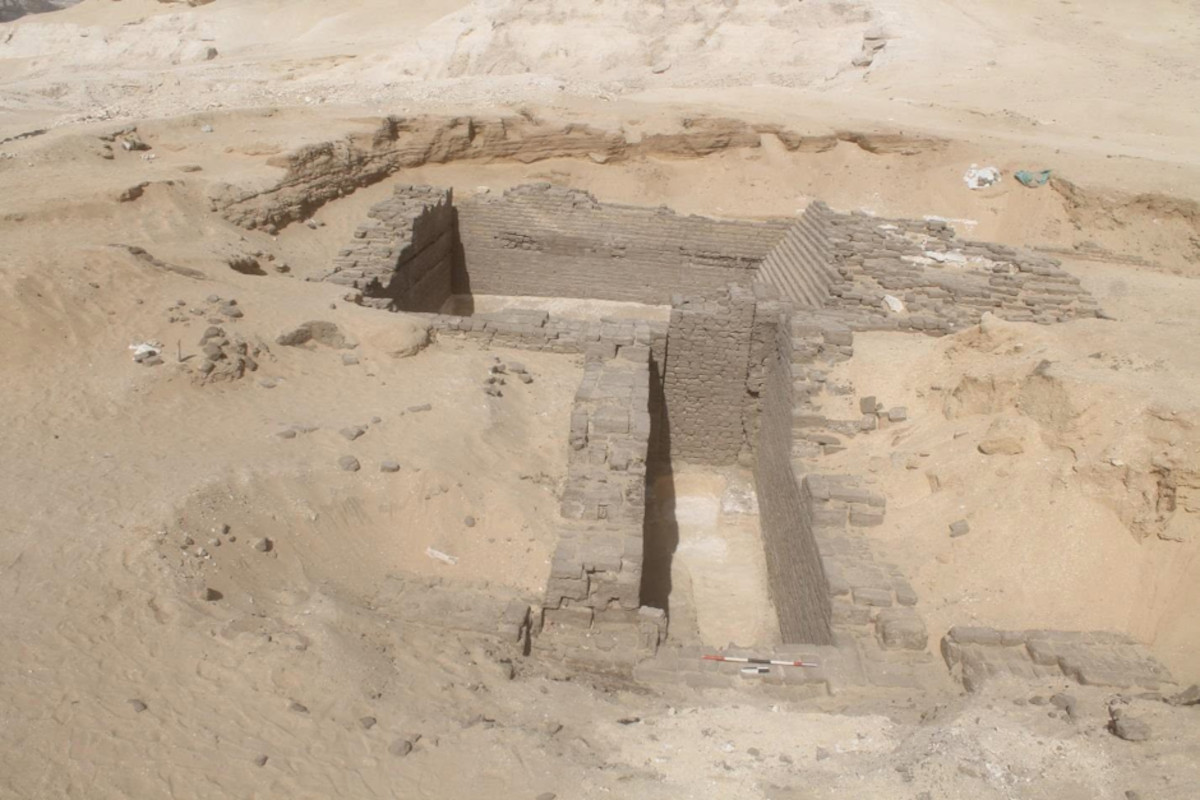
An Egyptian team has found two tombs at Jabal Al-Tayr, in Minya. They are about 5,000 years old. The dig was led by the Supreme Council of Antiquities. The site is on the east bank of the Nile. People had already known it as an old burial ground.
The two tombs date to the Early Dynastic Period. The team also found graves from earlier times, and graves from a much later time called the Late Period.
Sherif Fathy, Egypt’s Minister of Tourism and Antiquities, said the find helps show how tomb building changed over a long time. He said Jabal Al-Tayr was an important burial place, used again and again for thousands of years.
The first tomb has walls that get thinner from the bottom to the top. Mohamed Abdel Badie, head of the Egyptian Antiquities Sector, said this shape was an early way to make a wall steady. The article says this idea later grew into the way step pyramids were built, and then true pyramids. It says this is how the shape is understood. It does not show that these two tombs are the place where pyramids began.
Later people cut stone from the first tomb. Parts of it still show how it was built. Lines on the stone, which the article calls oxide lines, were guides for cutting. Big wooden supports were set into the walls to hold them up.
The second tomb is just to the south. It has almost the same plan. It is in better shape, because later people did not cut stone from it.
Early studies say these tombs look a lot like the tomb of King Den at Abydos. King Den was a leading ruler of the First Dynasty. His tomb is known for a staircase down to the burial room. The article says that was the first known use of such a stair. It does not say the Minya tombs have that stair. It says the similar plans point to a shared way of building, in the early days of the Egyptian state.
The team also found part of an older cemetery, from before the first kings. The people there were laid in a crouched position. They were wrapped in mats made of plants. Most of those mats have worn away. Black-topped pots from the Naqada II and Naqada III periods were found with these graves. The article says those periods come before Egypt was joined under one rule.
The team also found single graves and group graves from the Late Period. Some people were placed in wooden coffins. Pieces of those coffins remain. The dig is still going on.
What was found: two Early Dynastic tombs, older crouched burials with black-topped pots, and later graves, some in wooden coffins. Where: Jabal Al-Tayr, in Minya, on the east bank of the Nile. When: the two tombs are about 5,000 years old. The article is dated 21 June 2026. It does not give the day the tombs were found.
From an Ancient Origins article by Gary Manners, 21 June 2026.
On 21 June 2026, Ancient Origins reported a new find from Egypt. An Egyptian archaeological mission, led by the Supreme Council of Antiquities, had uncovered two tombs at Jabal Al-Tayr, in Minya Governorate. The site is on the east bank of the Nile. It had long been known as an important burial ground. Known.
The two tombs date to the Early Dynastic Period and are about 5,000 years old. The team also found part of a Predynastic cemetery, from before Egypt was united under one rule, and burials from the much later Late Period. The report gives the age of the tombs but does not say how it was worked out. Known.
The first tomb is the one behind the headline. Mohamed Abdel Badie, Head of the Egyptian Antiquities Sector, explained that its walls get gradually thinner from the base to the top. In later periods, people quarried this tomb for its stone. Even so, the parts that survive still show how it was built. Archaeologists found oxide lines on the stone surfaces, which served as guidelines for cutting the stone precisely. They also found large wooden supports built into the structure to strengthen the walls. These details were seen in the tomb itself, so they are Known.
The second tomb lies just south of the first. Its plan is nearly identical. It is in much better condition, because it escaped the later quarrying. Known.
Preliminary studies by the research team found striking similarities between these tombs and the tomb of King Den at Abydos. King Den was one of the most prominent rulers of Egypt's First Dynasty. His tomb is famous for its advanced design, including the first known staircase leading down to a burial chamber. The report does not say that the Minya tombs have a staircase. It says the likeness suggests a shared way of building in the early days of the Egyptian state. "Preliminary" means these are first results, not final ones. The likeness is Known as an early finding.
The older graves tell a different part of the story. The Predynastic people were buried in a crouched, or contracted, position. They were wrapped in woven plant mats, which have mostly rotted away. Beside these graves lay black-topped pottery vessels of a kind typical of the Naqada II and Naqada III periods. Those periods come before Egypt was united. The style of the pots is the clue that ties these graves to that early time, long before the first pharaohs ruled. Known.
The latest burials date to the Late Period. Some people were buried alone and others in group graves. Some lay in wooden coffins, and remnants of the wood have survived despite heavy decay. Known.
Taken together, the graves show one site used again and again: from the Predynastic era, through the Early Dynastic Period, and into the Late Period. Sherif Fathy, Egypt's Minister of Tourism and Antiquities, said the find gives valuable evidence for tracing how tomb design changed across different eras. He said it confirms Jabal Al-Tayr as a key necropolis, or large burial ground, used continuously for thousands of years. The excavation is still going on. Known.
The headline says these tombs "rewrite the origins of Egyptian pyramid architecture". That is Debated. The evidence is the shape of one tomb's walls. Badie's view, which is the view the report gives, is more careful. He sees the thinning walls as an early engineering idea for making a building more stable. That idea, he says, later grew into the methods used for step pyramids, and in the end for true pyramids. The report uses the words "considered" and "suggests". It names no one who disagrees. Other news reports are just as careful. In Ahram Online, Hisham El-Leithy, Secretary-General of the Supreme Council of Antiquities, said the design "may represent an early stage" in the ideas that led to step pyramids and then true pyramids. Archaeology magazine reported his view as "perhaps" an early stage. Both views come from Egypt's own antiquities service. No published view from an independent expert was found. So the view the report supports is that this was an early step in a long story, not proof that pyramids started at Jabal Al-Tayr. The studies are preliminary, the dating method is not given, and the dig continues, so more may be learned.
Sources:
https://www.ancient-origins.net/news-history-archaeology/minya-tombs-jabal-al-tayr-00102901