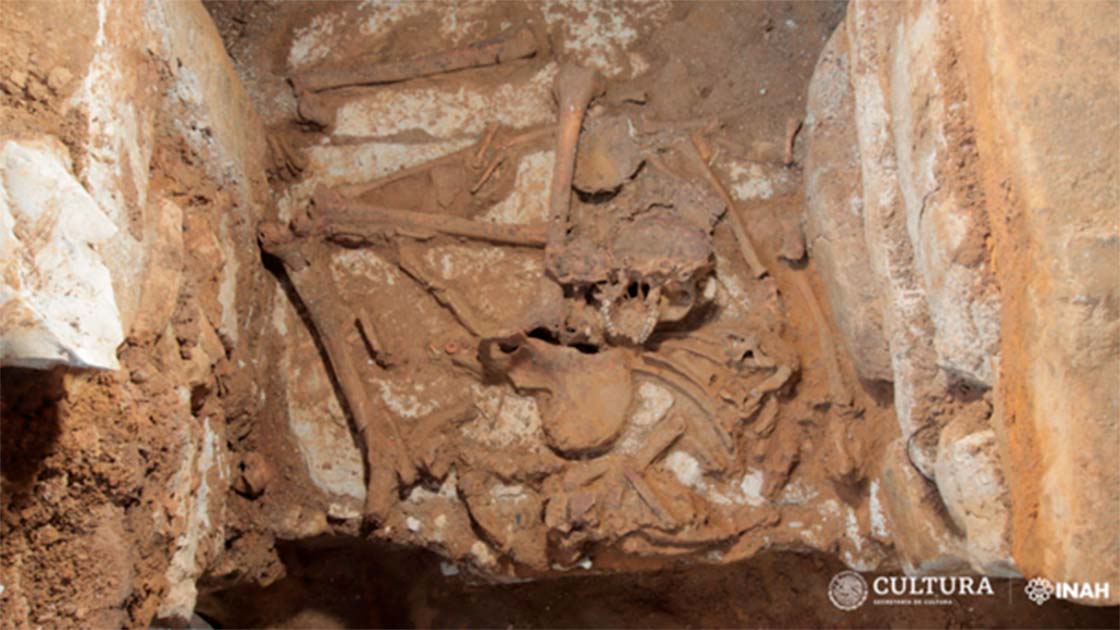
A burial chamber has been found at the Maya city of Palenque. It is inside a structure called CP3. The article says the city is home to the Red Queen's Red Palace. Digs and restoration there have gone on for decades.
The chamber held a complete human skeleton. It also held several large ceramic bowls. The article says the bowls were offerings. As a Maya custom, such bowls were left for a reason. They were to nourish the dead person in the afterlife. The article says the burial hints at a funerary custom reserved for the elite.
There was a second burial as well. INAH reported the offering. INAH is the National Institute of Anthropology and History. The offering had three plates. It had a niche of green stone figures. The bones were a woman's. The article says she was probably buried in a different place first.
The dig was salvage work in CP3. The structure is being improved under the Program for the Improvement of Archaeological Zones. That programme is called Promeza. INAH is doing this for the Mexican Ministry of Culture. The stretch of work runs from Palenque to Escárcega. Palenque is in Chiapas. Escárcega is in Campeche.
Diego Prieto Hernández is the general director of INAH. He said the area is being prepared for more visitors. The number is expected to exceed 500,000 a year. The Visitor Service Center is called Catvi. He said it shows progress from 83 to 87 percent. The museum is being rehabilitated. Its electrical installations are being renovated. So are its plumbing installations. The article says the salvage digs are almost done. Study of the finds goes on. The museum is updating its scientific script. New signs for the zone are being made. Walkways are being repaired. This includes the newly opened Group IV.
A picture caption links the dig to train works. It says the chambers were found ahead of the planned Maya train construction. The article does not give the day of the dig. The article is dated 21 March 2023. It cites an INAH report of 20 March 2023.
The article also tells the wider story of the city. Palenque is in southern Mexico, in Chiapas. It is near the border with Guatemala. The city had its peak in the 7th century AD. It was one of the main cultural and political centres of the Maya. People first lived there around 100 BC. It flourished in the Late Classic, from about 600 to 800 AD. Powerful kings oversaw famous buildings. One is the Temple of the Inscriptions. One is the Red Palace. One is the Temple of the Cross. The Temple of the Inscriptions holds the tomb of Pakal the Great. The article says that tomb, with its carvings and artefacts, gives insight into Maya beliefs. Those beliefs are about death and the afterlife. This new chamber is not that tomb. The city was abandoned sometime in the 9th century. Explorers found the ruins again in the 18th century.
What was found: a burial chamber in CP3. It held a complete skeleton and large ceramic bowls. It also held a woman's burial, three plates, and green stone figures in a niche. Where: Palenque, in Chiapas, southern Mexico, near Guatemala. When: the article does not give the day of the dig. It is dated 21 March 2023. It cites an INAH report of 20 March 2023. The article says the city flourished from about 600 to 800 AD.
From an Ancient Origins article by Sahir Pandey, 21 March 2023.
Palenque is an ancient Maya city in Chiapas, in southern Mexico, near the border with Guatemala. People first lived there around 100 BC. The city flourished in the Late Classic period, from about 600 to 800 AD, and reached its peak in the 7th century AD. It was one of the main cultural and political centres of the Maya. It was abandoned sometime in the 9th century, and explorers found the ruins again in the 18th century. Known as the history the report gives.
Powerful kings built famous temples and palaces there. The report names the Temple of the Inscriptions, the Red Palace and the Temple of the Cross. The Temple of the Inscriptions holds the tomb of Pakal the Great. The report calls Palenque the home of the Red Queen's Red Palace. Digs and restoration have gone on at the city for decades. Known.
In March 2023 archaeologists from INAH, Mexico's National Institute of Anthropology and History, reported a new find. It was a burial chamber inside a building called structure CP3. This is not Pakal's tomb. It is a separate, newly found chamber. Known.
The chamber held two kinds of burial. Archaeologists call a body laid to rest in its first and only grave a primary burial. A secondary burial is when bones are moved and laid in a new place. Here the primary burial was a complete human skeleton. It lay face up and was turned towards the north. Several large ceramic bowls had been placed in the chamber as offerings. Known.
The secondary burial held the bones of a woman. With it was an offering of three plates, and a niche, a small hollow in the wall, holding a group of green stone figures. The report says the woman was probably buried somewhere else first. Later, when the chamber was reopened, her bones were placed in the antechamber, the entrance space in front of the main chamber. Known for the bones, plates and figures. The first burial place is a "probably".
Why were the bowls there? The report says that, by Maya custom, bowls like these were left to nourish the dead person in the afterlife. That is a belief about the afterlife. Archaeologists can show where the bowls were placed. They cannot watch what the Maya believed would happen. Myth, as a belief, not an event.
How did the dig happen? It was salvage archaeology. That means digging carefully and recording a site before building work disturbs it. CP3 was being improved under Promeza, the Program for the Improvement of Archaeological Zones. INAH runs this for Mexico's Ministry of Culture. A picture caption says the chambers were found ahead of the planned Maya train construction. The work runs on a stretch from Palenque, in Chiapas, to Escárcega, in Campeche. Known.
Diego Prieto Hernández, the general director of INAH, said Palenque expects more than 500,000 visitors a year. A Visitor Service Center, called Catvi, was 83 to 87 percent built. The museum was being repaired, and its scientific script and signs were being updated. Walkways were being repaired, including in the newly opened Group IV. INAH said that by 20 March 2023 this wider work had recovered 2,655 remains of buildings, 218 movable objects, 255,683 pottery fragments, 177 human burials and 38 natural features. Study of the finds goes on. Known.
Was this the grave of a member of the elite? The report says the way the skeleton lay, face up and facing north, "hints at a funerary custom exclusively reserved for the elite". INAH's own bulletin of 20 March 2023 describes the same position in a different way. In Spanish it calls it "algo habitual en las antiguas costumbres funerarias de Palenque". In English that means something usual in the ancient funeral customs of Palenque. The bulletin does not say the position was only for the elite. INAH also says the woman "probablemente", or probably, was buried somewhere else first. So the elite reading and the first burial place are both Debated. Neither report says who the people in the chamber were. Debated.
Sources: - Instituto Nacional de Antropología e Historia (INAH), "Reportan el hallazgo de una cámara funeraria en Palenque durante trabajos del Tren Maya", Boletín 149, 20 March 2023. https://www.inah.gob.mx/boletines/reportan-el-hallazgo-de-una-camara-funeraria-en-palenque-durante-trabajos-del-tren-maya (in Spanish; English wording in the story is a translation)
Sources:
https://www.ancient-origins.net/news-history-archaeology/palenque-burial-0018100