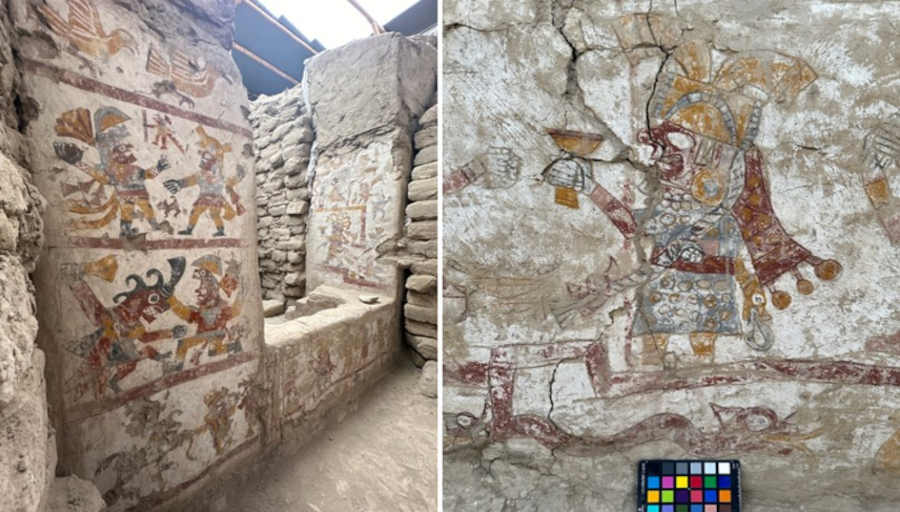
A team found a throne room with pillars at Pañamarca. The site is in the Nepeña Valley, on the north coast of Peru. Pictures show who used the room. She was a woman of high rank. The article says she was likely a priestess or a queen.
The find was in July. The project began in 2018. Its name is Archaeological Landscapes of Pañamarca. Captions date the new paintings to 2024. The article is dated 28 September 2024. It does not give the day in July.
Pañamarca is the most southern big centre of the Moche. Moche people lived in the coastal valleys of northern Peru. The article says this was about 350 to 850 AD. The site is on a granite hill. It has a tall stepped platform of adobe. It has two lower platforms of adobe. It has a large walled plaza of adobe. It has other buildings. One is a masonry building from the Formative period.
Teams from Peru and the US do the work. Support comes from the National Geographic Society. It also comes from Columbia University. The funder there is the Institute of Latin American Studies. Support also comes from the Denver Museum of Nature and Science. The centre there is the Avenir Conservation Center.
The site is known for bright wall paintings. They were first published in the 1950s. They show priests and warriors in lines. They show battles of beings that are not human. They show a man with two faces. A throne room for a queen has not been seen here before. The article says it has not been seen in the rest of ancient Peru.
The throne is made of adobe. It stands in a hall. Jessica Ortiz Zevallos leads the project. She named the hall the Hall of the Moche Imaginary. The article also calls it Sala del Imaginario Moche. Four scenes show the woman. In some she meets visitors. In one she sits on the throne. She is also painted inside the throne.
Older paintings in this hall show men and women in fine clothes. They show warriors with spider, deer, canid, and serpent parts. They show a hero of myth fighting sea enemies. These are paintings. The article does not call them a real fight.
The painted woman is linked to the crescent moon. She is linked to the sea and its creatures. She is linked to spinning and weaving. New paintings show a rare scene. A group of women spins and weaves. Men in a line carry cloth. They carry her crown, with her braids. One painting shows her lifting a goblet.
Lisa Trever teaches art history at Columbia University. She said the site keeps surprising them. She said the painters change what people expect of men and women in the old Moche world.
Scholars will argue about the painted woman. Is she a person, or a figure from myth? The article names three ideas. A priestess, a goddess, or a queen. The back of the throne is worn. The team found greenstone beads, fine threads, and human hair. The article says a real person used the throne. It points to a woman leader in the seventh century.
On the plaza, the team found a hall that was not known before. It is the Hall of the Braided Serpents. The article also calls it Sala de las Serpientes Trenzadas. Wide square pillars hold it up. Many show snakes with human legs, wound together. The article says this picture is not seen in other Moche art. Other pictures show warriors. They show anthropomorphized weapons. They show a large monster chasing a man. These are paintings.
People made the hall new more than once. They left many gifts, mostly cloth. There were fires. Floors were covered with care. Old painted walls were covered in whitewash.
Michele L. Koons works at the Denver Museum of Nature and Science. She said the hall looks over the plaza. People there could see what happened below. They also had private rooms for people of high rank.
The team records the paintings and then covers them. They are too fragile for tourists. José Antonio Ochatoma Cabrera said open murals fell apart in the 1950s. Each season the team covers the digs. They follow Peru's Ministry of Culture. The team is building roofs and wind breaks. The ministry has built some too. Copies go on Pañamarca Digital, which opened in 2023. The ministry in Lima watches the work. So does the Dirección Desconcentrada de Cultura de Ancash.
What was found: a painted throne room with pillars, used by a woman of high rank, and a second hall with paintings of braided snakes. Where: Pañamarca, on a granite hill in the lower Nepeña Valley, on the north coast of Peru. When: the find was in July, and captions date the paintings to 2024. The article is dated 28 September 2024. It does not give the day. The Moche are placed about 350 to 850 AD. The woman leader is placed in the seventh century.
From an Ancient Origins article, 28 September 2024. The page says this is an edited press release from Pañamarca Digital and the Denver Museum of Nature & Science.
Pañamarca stands on a granite hill in the lower Nepeña Valley, on the north coast of Peru. It was built by the Moche, a people who lived in the coastal valleys of northern Peru between about 350 and 850 AD. Pañamarca is the most southern of their monumental centres. It has a tall stepped platform made of adobe, which is mud brick. It also has two lower but wide adobe platforms, a large walled adobe plaza, and other buildings. One is a stone building from the earlier Formative period. Known.
The site has been famous since the 1950s for its brightly coloured wall paintings. They show priests and warriors walking in procession, battles between supernatural beings, and an unusual man with two faces. Known.
A research project called Archaeological Landscapes of Pañamarca began in 2018. Peruvian and US archaeologists, art historians and conservators work together on it. Support comes from the National Geographic Society and from Columbia University's Institute of Latin American Studies. It also comes from the Avenir Conservation Center at the Denver Museum of Nature & Science. Ancient Origins printed an edited version of their press release on 28 September 2024. Known.
In July the team uncovered a pillared hall with an adobe throne inside. Photo captions date the new paintings to 2024. The project director, Jessica Ortiz Zevallos, named it the Hall of the Moche Imaginary, or Sala del Imaginario Moche in Spanish. Its walls and pillars show four scenes of a powerful woman. In some, people come to her in procession. In one, she sits on a throne. She is also painted on the inside of the real throne. On the outside, a painting shows her wearing a crown and raising a goblet. The report says a throne room for a queen had never been seen before. Not at Pañamarca, and not anywhere else in ancient Peru. Known.
In the paintings, the woman is linked with the crescent moon, the sea and its creatures, and the crafts of spinning and weaving. One rare scene shows a whole workshop of women spinning and weaving. Another shows a line of men carrying cloth and the woman's crown, complete with her braids. Earlier seasons had found more paintings in the same hall. They show finely dressed men and women, warriors with spider, deer, canid and serpent features, and the Moche mythic hero fighting enemies from the sea. These are paintings of stories, not records of real fights. Known.
On Pañamarca's plaza, the team found a second large building that nobody had known about. They call it the Hall of the Braided Serpents. Many of its wide square pillars are painted with snakes that have human legs, twisted around each other. The report says this design is not seen anywhere else in Moche art. Other surfaces show warriors, weapons painted like people, and a large monster chasing a man. Known.
How can archaeologists tell what happened in this hall over time? They read its layers. People renewed the hall several times. They left many offerings, mostly cloth. There were burning events. They carefully covered over old floors, and painted over older decorated walls with whitewash. Michele L. Koons works at the Denver Museum of Nature & Science. She said the hall gave a view over the plaza, "almost like box seats at a theater or stadium". It also had private spaces for important people. Known.
The paintings are fragile, so they are not open to tourists. José Antonio Ochatoma Cabrera is an archaeologist on the project. He said the murals first uncovered in the 1950s began to fall apart once they were left open. So at the end of each season the team covers the excavations, following Peru's Ministry of Culture. The team and the ministry are building roofs and windbreaks. The team records everything with pencil and watercolour drawings and 3D digital scans. It shares them on its website, Pañamarca Digital, which began in 2023. Known.
Who was the woman? The report says scholars will debate whether she is human or mythical, "a priestess, goddess, or queen". The title of the press release links her with a Moon Goddess. But the throne itself gives physical clues. Its back support is worn away, and the team found greenstone beads, fine threads and human hair on it. The report says this makes clear a real living person sat there. It says the evidence points to a woman leader of Pañamarca in the seventh century. Columbia News, from Lisa Trever's university, reports the same clues. It says they suggest the throne was used by a real person, "perhaps the female leader shown in the paintings". It says the throne room was built around AD 650. Trever said experts have tended to call high-status Moche women "priestesses", but these paintings show such a woman "raising a scepter, enthroned within a temple". Columbia News adds that whether these women were warrior-queens or divine rulers is still being researched. So a real woman using the throne is well supported. Whether the painted woman was a queen, a priestess or a goddess is Debated.
Sources: - Christopher D. Shea, "Columbia Archaeologist Unearths 'Thrilling' New Findings in Peru", Columbia News, Columbia University, 15 November 2024. https://news.columbia.edu/news/columbia-archaeologist-unearths-thrilling-new-findings-peru (read from the archived copy at https://web.archive.org/web/2024/https://news.columbia.edu/news/columbia-archaeologist-unearths-thrilling-new-findings-peru)
Sources:
https://www.ancient-origins.net/news-history-archaeology/moche-throne-room-pa-amarca-0021492