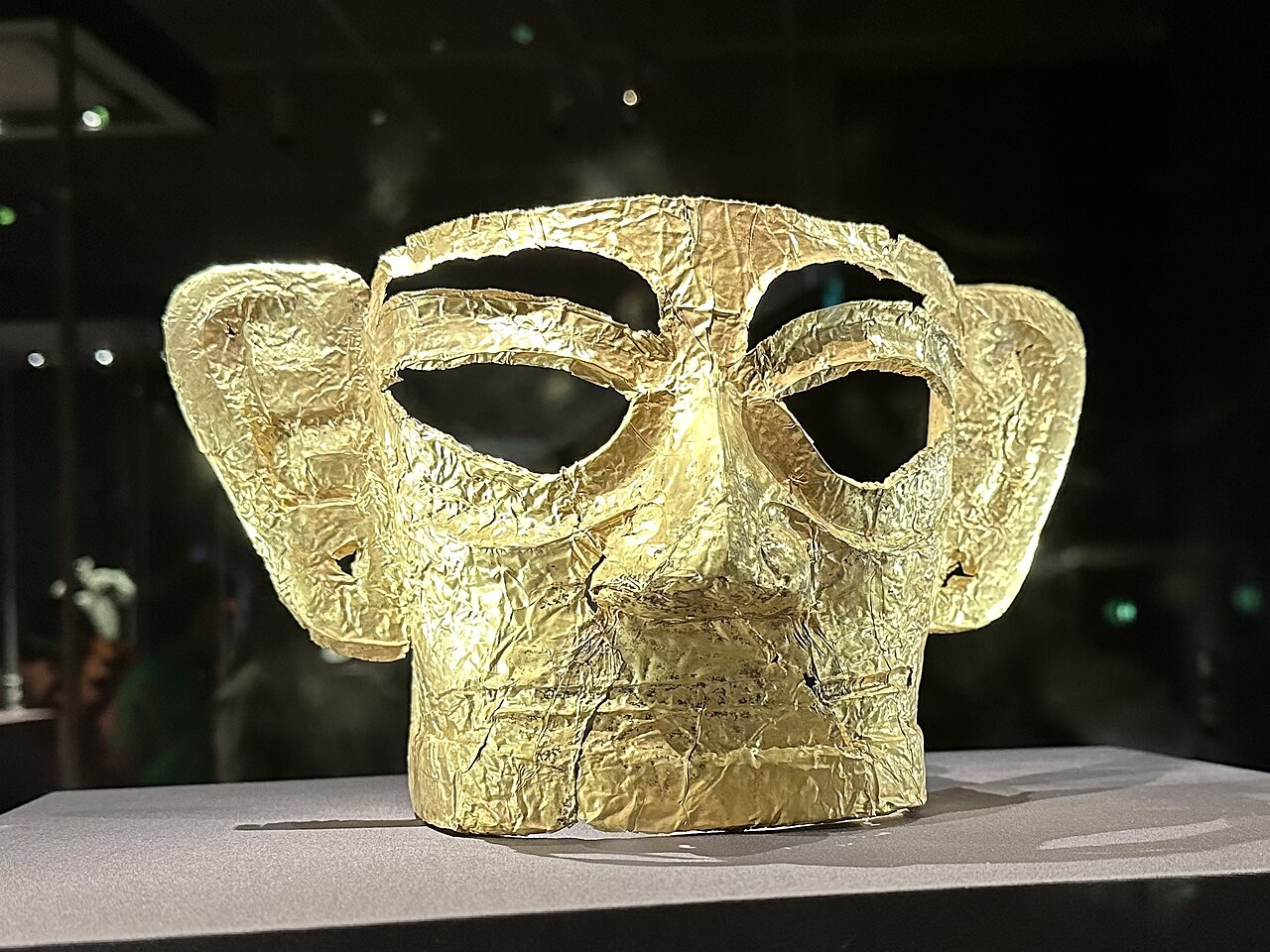
A team in China has found thousands of old objects at Sanxingdui. The site is in Sichuan province. This culture was not known until the 1980s. Sanxingdui means Three Star Mound. It was found by accident in 1986.
Since October 2020, a very large number of objects has come from the site. In the latest dig, the team worked in the pit area. On the Monday just before this article, they reported a store of objects from six pits. The report came through the news agency Xinhua.
One new find is a bronze box with jade on it. The top is shaped like a turtle's back. It is bronze and jade, with turquoise jade on it. It has four handles shaped like dragon heads. It also has a few streamers. The article says it was likely wrapped in silk.
Li Haichao leads one dig team. He is a professor at Sichuan University. He said no one is sure what the box was for. He said we can assume people treasured it.
Another find is a crowned bronze statue with a snake's body. Ran Honglin said it was the most important recent find. He leads the research institute at the site. The statue has three parts. The snake's body is the middle part. The hands rest on a bronze drinking vessel called a lei. That sits on a square base. The man has features of the Shu kingdom. Above all, his eyes stick out. A painted zun sits on his head. A zun is another kind of bronze drinking vessel. The paint is vermilion. His nose is a pig's nose.
Zhao Hao led the work at pit number 8. He teaches at Peking University. He said this complex piece shows a vivid imagination. He also spoke of visions of a mystical world.
A bronze altar was found too. It is nearly a metre tall. It has three parts. The bottom is a platform with hollow patterns. A muscular person sits in the centre of each part.
The craft shows a high level of skill. The article says the site is viewed as the ancient kingdom of Shu. Dating puts the culture nearly 3,300 years ago.
A new round of carbon dating looked at 200 objects. Most pits date from 1131 to 1012 BC. The article says this was probably the late Shang dynasty. That dynasty lasted from the 16th century BC to the 11th century BC. Pits number 5 and 6 date to after it.
Ran Honglin said the team had never seen things like these. It is hard to say how they were used, until there is more study. The objects mix local styles with styles from the Central China Plains. He said close contact made Shu culture a key part of early Chinese civilisation. The article says China was fully joined under one rule only in the Han dynasty, from 202 BC on.
A zun motif on one new object was almost unknown in Shu. It was common in the Zhongyuan Central Plains. The writer says the motif was borrowed.
The field dig was planned to finish in October 2022.
What was found: a bronze box with jade, a crowned bronze statue with a snake's body and a pig's nose, and a bronze altar, among thousands of objects. Where: Sanxingdui, in Sichuan province, in six pits. When: the team reported the finds on the Monday just before this article, dated 14 June 2022. The article does not give a calendar day for each object. Work has gone on since October 2020. Most dated pits fall in 1131 to 1012 BC.
From an Ancient Origins article by Sahir Pandey, 14 June 2022.
Sanxingdui, which means Three Star Mound, is in Sichuan province in south-west China. It was found by accident in 1986. The culture behind it was not known until the 1980s, and the report says it was left out of official records. Known.
On 14 June 2022, Ancient Origins reported news from Xinhua, the Chinese state news agency. On the Monday before, archaeologists had announced a large store of objects from six pits at the site. Since October 2020, the number of objects recovered had reached 13,000. The latest dig explored 1,834 square metres of the pit area, which covers almost 13,000 square metres in all. The pits have given up 3,155 fairly complete objects, including 1,238 pieces of bronzeware, 543 gold objects and 565 jade objects. Known.
One of the newest finds is a bronze box decorated with jade. Its lid is shaped like a turtle's back, made of bronze and jade with turquoise jade decoration. It has four handles shaped like dragon heads, and a few streamers. The report says it was likely wrapped in silk. Li Haichao, a professor at Sichuan University who leads one of the dig teams, called it an "unprecedented discovery". Known.
Another find is a crowned bronze statue with a snake's body. Ran Honglin, director of the Sanxingdui research institute for cultural relics and archaeology, called it the most important recent find. The statue has three sections, with the snake's body in the middle. The figure's hands rest on a bronze drinking vessel called a lei, which sits on a square stand. The face has features typical of the Shu kingdom, especially eyes that stick out. On its head is a zun, another kind of bronze drinking vessel, painted vermilion, a bright red. Its nose is a pig's nose. It came from pit 8, where the dig was led by Zhao Hao, an associate professor at Peking University. Known.
A bronze altar nearly a metre tall was found too. It has three sections. The bottom is a platform with hollow patterns, and a muscular figure sits at the centre of each section. Known.
How do archaeologists know how old the pits are? In a recent round of carbon dating, they tested 200 objects. Most of the pits were dated to between 1131 and 1012 BC. Pits 5 and 6 were dated to after the Shang dynasty, which the report says lasted from the 16th to the 11th century BC. Known.
The objects show great skill, and researchers have remarked on the metalworking of the Shu people. Ran Honglin said the team had never seen objects like these, and could not yet say how they were used. He said they mix local styles with styles from the Central China Plains, and that close contact made Shu culture a key part of early Chinese civilisation. The report notes that China was only fully united under one rule in the Han dynasty, from 202 BC. Field digging was due to finish in October 2022. Known.
Several points are Debated, because the report itself hedges them. First, Li Haichao said the use of the box "remains in doubt", although "we can assume that ancient people treasured it". Second, most pits are "probably" from the late Shang dynasty. Archaeologists from Sichuan University, writing in the journal Antiquity, said the dating of the pits "has been long debated". Going by the objects and the way they were buried, they placed most pits in a phase called Yinxu Phase IV, about 1200 to 1000 BC, and pits 5 and 6 "probably" in the early Western Zhou period, about 1046 to 950 BC. Six radiocarbon dates from pit 4 gave a range of 1260 to 924 BC. These fit the report's dates closely, but the experts still say "probably". Third, Sanxingdui is "viewed to be" the ancient kingdom of Shu. That is the usual view, not a proven fact, and no outside source was checked on it for this story. Fourth, Zhao Hao reads the statue as a sign of "a vivid imagination and visions of a mystical world", and the report says the altar is new evidence of the Shu people's view of an immortal world. These are readings, not things the dig saw. Last, the writer says a zun pattern, almost unknown in Shu but common in China's Central Plains, was "clearly" borrowed. Ran Honglin's own view is mixed styles and close contact. The Antiquity paper agrees that the new objects let researchers explore exchange between the Chengdu Plain and the Central Plains, and with the middle and lower Yangzi River.
Sources:
- Yingfu Li, Tian Qiu, Jianbo Guo and Yuniu Li, "New discoveries at the Sanxingdui Bronze Age site in south-west China", Antiquity, volume 97, issue 391, e4. Published online 21 November 2022. https://doi.org/10.15184/aqy.2022.150
https://www.ancient-origins.net/news-history-archaeology/sanxingdui-0016894