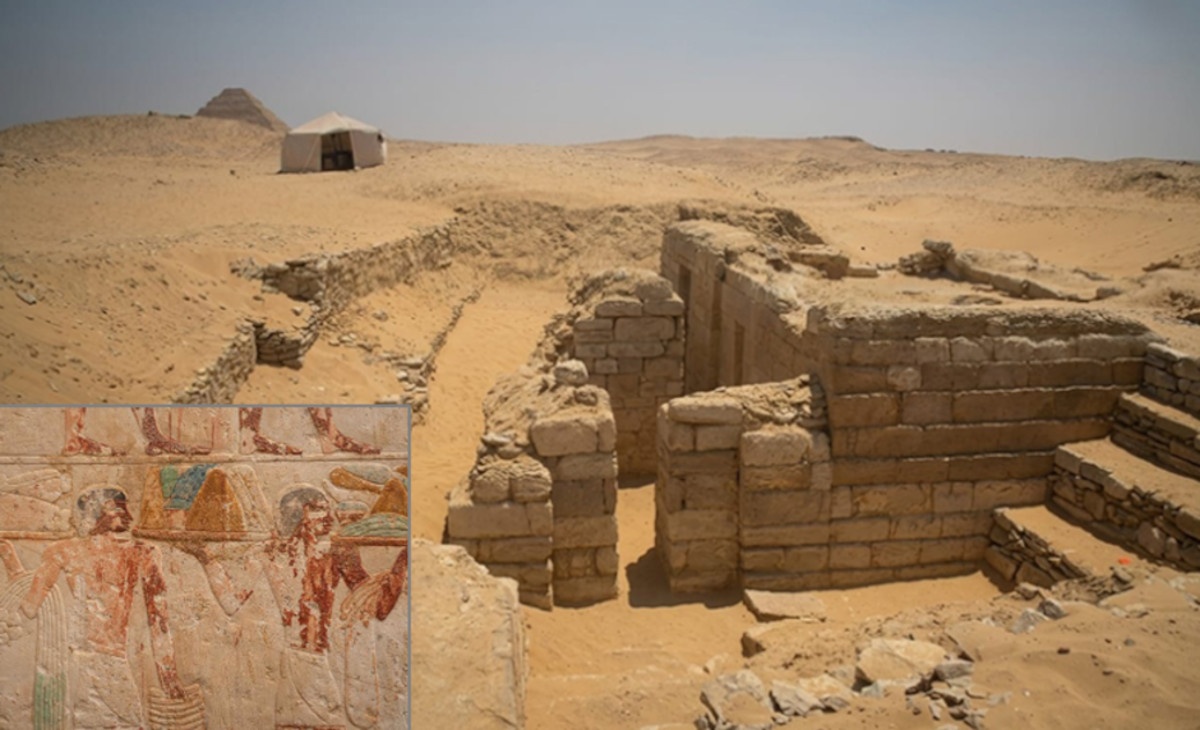
A team from Egypt and Spain found a tomb in 2026. It is at Saqqara, in Mariette Cemetery. Saqqara is about 40 kilometres (25 miles) south-west of Cairo. Long ago, this was a burial ground for the city of Memphis.
The tomb is medium sized. It is a mastaba, a tomb with a flat top. Two chapels sit on the east wall. The north chapel is for Yunmin. The south chapel is for his father, Ity.
The tomb dates to the end of the Fifth Dynasty. That was the time of King Djedkare Isesi. The article says this was about 4,400 years ago.
Yunmin was a judge. He directed the court. He led scribes who checked complaints and petitions. Ity did writing work about farm land. He also managed offerings.
The walls have raised pictures. The article says most of the original colours are still there. It also says the colour remains in some places. The pictures show farm work. They show people bringing offerings. The writing gives the names and titles of the two men.
Yunmin’s chapel has a front with burial messages, a row of offerings, and a picture of him. Ity’s chapel has a false door and coloured offering scenes. Most of Ity’s decoration has worn away.
The article says pictures of farming, hunting, and making food were common in rich tombs of the Fifth Dynasty. This tomb, as the article describes it, shows farm work and offerings. The offering pictures stood for providing for life after death. False doors and offering scenes were how living people kept that care going. The ministry report does not say that any body, or any grave goods, were found in this tomb.
People have known this spot since the 1800s. Auguste Mariette worked here then. This is the first time it has been dug and recorded in a scientific way. Hisham El-Leithy said the work shows the buildings, the art, and how officials worked in the late Fifth Dynasty. He is Secretary-General of the Supreme Council of Antiquities. The dig was a partnership between the Autonomous University of Barcelona and that council. The team has finished the dig and the records. They have also worked to protect the building, the writing, and the colour.
What was found: a medium mastaba with two chapels, one for Yunmin and one for his father Ity, with painted pictures on the walls. Where: Saqqara, Mariette Cemetery, about 40 kilometres south-west of Cairo. When: found in the 2026 season. The tomb dates to the end of the Fifth Dynasty, the time of King Djedkare Isesi, about 4,400 years ago.
From an Ancient Origins article by Gary Manners, 8 September 2026.
On 8 September 2026, Ancient Origins reported a find from Saqqara in Egypt. Saqqara lies about 40 kilometres (25 miles) south-west of Cairo. It was one of the main burial grounds of the ancient city of Memphis. For more than 2,000 years, people built royal pyramids, mastabas for the rich and decorated chapels there. Known.
A joint mission from Egypt and Spain found the new tomb during its 2026 season, in an area called Mariette Cemetery. The team was a partnership between the Autonomous University of Barcelona and Egypt's Supreme Council of Antiquities. The report is based on a release from Egypt's Ministry of Tourism and Antiquities. Known.
The tomb is a medium-sized mastaba. A mastaba is an Egyptian tomb with a flat roof and sloping sides, built over the burial. This one has two funeral chapels on its eastern wall. The main chapel, on the north side, belongs to a man called Yunmin. The chapel on the south side belongs to his father, Ity. Known.
How do archaeologists know who these men were and when they lived? The answer is written on the walls. Hieroglyphic inscriptions give the names and titles of the two men, who belonged to one family. Yunmin was a judge and director of the court. He was also head of the scribes who checked complaints and petitions. Ity was in charge of writing work about farm land, and of managing offerings. The tomb is dated to the time of King Djedkare Isesi, at the end of the Fifth Dynasty. The report says that was about 4,400 years ago. Known.
Yunmin's chapel has a decorated front with messages about burial, a sequence of offerings, and a detailed picture of Yunmin himself. Its walls have raised reliefs, carvings that stand out from the stone. They show people working on farms, and processions bringing offerings for the dead man. The report says most of the original colours survive. In another place it says the colours are still intact in some places. Ity's chapel has a false door and coloured offering scenes, but most of its decoration has decayed. Known.
A false door is a doorway carved into a wall that does not open. The report says false doors and offering scenes were part of how the living kept up the care of the dead. It says the offering pictures stood for the idea of providing for life after death. These are beliefs about the afterlife, not events anyone saw. Myth, as a belief.
The report compares the tomb with others from the same time. It cites the Metropolitan Museum of Art, which says pictures of farming, hunting and preparing food became common in rich tombs of the Fifth Dynasty. This tomb, as described, shows farm work and offerings. The report does not mention hunting scenes in it. The ministry's release does not say that any body or any grave goods were found in this tomb. Known as the report gives it.
People have known where this mastaba was since the 1800s, when the French archaeologist Auguste Mariette worked in the area. But it had never been properly dug or recorded until now. Hisham El-Leithy, Secretary-General of the Supreme Council of Antiquities, said the work gives evidence about the buildings, the art and the government of the late Fifth Dynasty. The team has finished digging and recording both chapels. It has also carried out conservation and restoration to protect the walls, the inscriptions and the colour. Known.
Is anything about this tomb Debated? The report does not set out a dispute, and no outside source is needed. The only thing to watch is wording. The report says both that most of the colours survive and that they remain in some places. It also does not say how the date of about 4,400 years ago was worked out, beyond naming the king. Known as gaps in the report.
Sources: - None. No outside source is used, because the report sets out no Debated point.
Sources:
https://www.ancient-origins.net/news-history-archaeology/fifth-dynasty-tomb-saqqara-00103159