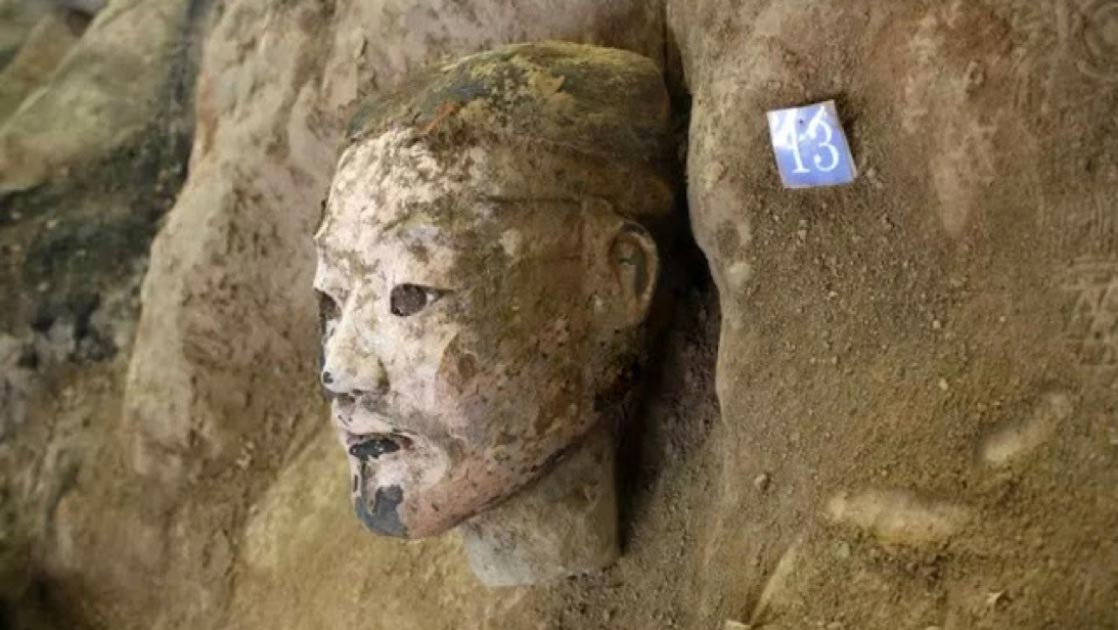
Chinese archaeologists have found more than 220 terracotta warriors. They were in the mausoleum of the First Emperor, Qin Shi Huang. The new figures came with five official titles. Those include senior military ranks. They also include a rank called “lower than the lowest”. The page does not name the other new titles.
The page says the Terracotta Army is a set of earthenware sculptures. They mirror the ranks, uniforms, and weapons of real soldiers. Those soldiers were of the Qin dynasty, from 221 to 206 BC. The figures were interred with Qin Shi Huang around 210 BC. The page says they were designed to defend him in the afterlife. The page says it is believed that he was obsessed with achieving immortality. That is the purpose the page gives. It is not a report that the clay army fought after he died.
The clay army was found at Xi'an, in the north-west of China, in the 1970s. It was found by chance. This new find came after a decade of excavations.
Liu Zheng, of the China Cultural Relics Academy, said the warriors are lined up the same way as real Qin soldiers. The page says skilled craft people made them in a very realistic way. They hold real weapons, such as crossbows. The page says those weapons could have been used in battle. The page says the figures are believed to be modelled on real soldiers of this emperor. The sculptures were all painted, often in vivid colours.
The army was set in pits around the tomb. Since 2009, the team has worked in a place called pit one. There they found more than 220 new soldiers. They were well preserved. Liu said that when the figures were first dug out, they were mostly coloured.
Officers stood at the front. They had swords. Their hair accessories were not the same as those of the common soldiers. A dozen clay horses were found too. The horses are life-size. The rank “lower than the lowest” was identified for the first time. Other new officer ranks were found as well. The page says the ranks help show how the army was organised. The page says this can also help show how he conquered a great number of states over a large area.
Other finds were military tripods and crossbows. There were golden sabres. There were also spoons, plates, tinctures, and kettles. Near the figures was a small golden camel. The page says the camel is a realistic Bactrian camel. That kind was widely used by traders. The page says this is the earliest known one found in China. It may help researchers understand Chinese trade with the outside world before the Silk Road.
The aim now is to conserve the figures, especially their colours. The page says improved technologies let the new figures keep their vivid colours. The team hopes to keep digging, and to conserve what they find. The page says more of these warriors are believed to be still in the tomb.
What was found: more than 220 terracotta warriors, and five official titles. One title is the rank “lower than the lowest”. Also a dozen life-size clay horses, weapons, everyday items, and a small golden camel. Where: pit one, in the mausoleum of Qin Shi Huang, at Xi'an, in the north-west of China. When: the figures were interred around 210 BC. Work in pit one has gone on since 2009. The army was first found by chance in the 1970s. The page does not give the day these 220 figures were found. The article date is 1 January 2020.
From an Ancient Origins article by Ed Whelan, 1 January 2020.
Qin Shi Huang was the First Emperor of China. He ruled during the Qin dynasty, which lasted from 221 to 206 BC. When he was buried, around 210 BC, a huge army of clay soldiers was buried with him. This is the Terracotta Army. Terracotta is a kind of earthenware, or baked clay. The sculptures copy the ranks, uniforms and weapons of real Qin soldiers. Known.
The report says the army was designed to defend the emperor in the afterlife. It says he is believed to have been obsessed with living forever. That is the purpose the figures were made for, and a belief about the emperor. It is not something that happened. Myth, as a belief.
The army was found completely by chance in the 1970s, at Xi'an in north-west China. The figures were placed in a series of pits around the emperor's tomb. Since 2009, Chinese archaeologists have been digging in one of them, known as pit one. On 1 January 2020, Ancient Origins reported that after about ten years of careful work there, they had found more than 220 new terracotta soldiers. The figures were well preserved. Known.
Liu Zheng of the China Cultural Relics Academy said the warriors are "lined up the same way as real soldiers" were in the Qin dynasty. The figures were made in a very realistic way by skilled craft workers. They even hold real weapons, such as crossbows, which could have been used in battle. All the sculptures were painted, often in bright colours. Liu said that when the new figures were first dug out, they were mostly coloured. Known.
The new find matters because of the ranks. The new warriors came with five different official titles. They include senior military ranks and a new rank nicknamed "lower than the lowest", which was identified for the first time. Officers stood at the front. They carried swords and had different hair accessories from the ordinary soldiers. The report says the ranks give new evidence about how the army was organised. It says they can help explain how the emperor conquered so many states over such a large area. The report does not name the other new titles. Known.
A dozen life-size clay horses were found with the warriors. So were military tripods, crossbows, golden sabres, and everyday things such as spoons, plates, tinctures and kettles. Near the figures, the team found a small golden camel. The report calls it a very realistic Bactrian camel, a kind that traders widely used in ancient times. It says this is the earliest one known to be found in China. It may help researchers understand China's trade with the outside world before the Silk Road. Known.
In the past, the paint on terracotta figures often could not be saved. Now the aim is to conserve the figures, especially their colours. Liu said "improved technologies are enabling the newly found figurines to retain their vivid colors." The team hopes to keep digging while protecting what it finds. The report says more warriors are believed to remain in the mausoleum. Known for the aim. More warriors is a belief.
Were the warriors portraits of real soldiers? The report says "it is believed" the figures were modelled on real soldiers who served the emperor. A research project at University College London (UCL) has studied this. In a blog post from 5 December 2014, the team explained that it compared 3D models of 30 warriors' ears. None of the ears in that sample was identical to the next. The team said the idea that the warriors were inspired by real people is an exciting possibility "we should not discount". But it warned that "we cannot make any definitive claims" from 30 ears when the warriors have around 15,000 of them. It also said moulds were used for basic shapes, such as heads and hands, which "makes it rather unlikely" that whole warriors are faithful portraits. So real-soldier portraits are Debated. The report also does not explain how the new ranks were identified.
Sources: - Imperial Logistics: The Making of the Terracotta Army project, "The terracotta warriors and the 'portrait' debate", project blog, University College London, 5 December 2014. https://www.ucl.ac.uk/terracotta-army/news/2014/dec/terracotta-warriors-and-portrait-debate (read from the archived copy at https://web.archive.org/web/2023/https://www.ucl.ac.uk/terracotta-army/news/2014/dec/terracotta-warriors-and-portrait-debate)
Sources:
https://www.ancient-origins.net/news-history-archaeology/terracotta-warriors-0013079