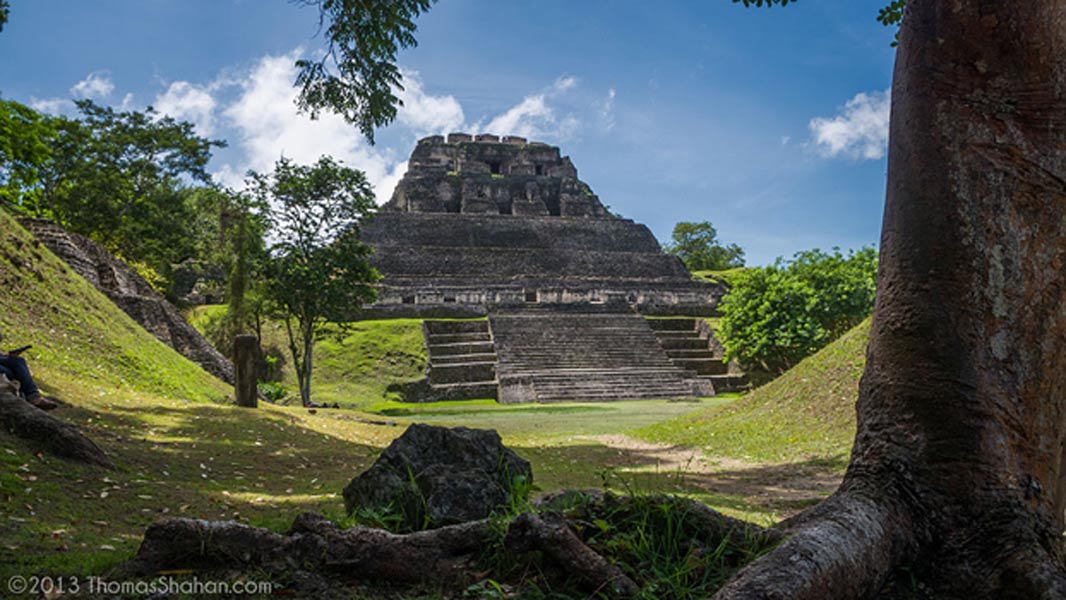
A large tomb has been found at Xunantunich, in Belize. This is an ancient Maya city. The article says this is the first tomb found there. Teams have worked at the site since the 1890s. In all that time, no tomb had been found.
The tomb held the skeleton of one person. Experts looked at the femurs. They looked at the skull and the teeth. They say he was a man of about 20 to 30 years old. The article says reverence was apparently shown in the way the tomb was built.
The team found ceramics and jade stones. They found the bones of an animal. They say it may have been a jaguar or a deer. They say this based on its long femurs.
Jaime Awe is an archaeologist on the team. The article quotes him. He said this is one of the largest burial chambers they have ever found. A first look shows the depth. The tomb is between 5 and 8 metres deep. That is 16.4 to 26.25 feet. The team still has to dig it fully. The article says the tomb was found last week. The article is dated 4 August 2016. It does not give a calendar day.
Xunantunich is a modern name. The article says it means Stone Woman. A local legend tells of a mysterious woman. In the late 1800s she appeared to a man from the village of San Jose Succotz. Then she disappeared into a wall at El Castillo. The article says she has reportedly appeared to others there. That story is a legend. It is not a find from the tomb.
El Castillo is a tall ancient building. The article says it is 40 metres tall. That is 131 feet. It was a shrine. It was an administrative hub. It was a home for the rulers. Large stucco friezes stand on the eastern summit. They also stand on the western summit. They have carvings of astronomical symbols. The symbols represent the sun god, the moon, and Venus.
The city sits on a limestone ridge. The ridge was artificially levelled. It is about 183 metres above sea level. That is 600 feet. Dwellings spread out from this centre for several square kilometres.
The article says people possibly settled here as early as 600 BC. The site did not reach its zenith for about 1,300 years. By then, many Maya cities in the region were declining. The article says the city flourished around 700 to 1000 AD. Then it declined.
In 1892, Dr Thomas Gann began to explore the site. He was a British medical officer. He dug for some years, then left. Work stopped until 1924, when he came back. The article says that on this second visit he unearthed many Maya treasures. Their history has been lost. No one knows where they are. The opening of the article says he excavated the site. It adds that some would say he looted it. It says museums and private collectors may show these items. They may not know where the items came from.
Since 1990, Richard Leventhal has been digging here. He is at the University of California at Los Angeles.
A stela appears to show an emblem. It is the emblem of Naranjo, a large city in what is now Guatemala. The article says this suggests Xunantunich was a satellite of Naranjo. Later, the influence and authority of Naranjo waned. The elites of Xunantunich possibly took control of their own city. They tried to improve it. There was major building on El Castillo and on other buildings. The article quotes Belize.com on what came next. It says the Xunantunich lineage was not to outlast their former Naranjo patrons by much.
Building slowed after 830 AD. By 900 to 1000, the city was far from its 8th and 9th century scale. Archaeologists have tentatively concluded something. The city was reoccupied in the 10th century. This was after a time when people had left.
The article says the site now has a visitor's center.
What was found: the first tomb at Xunantunich. It held a man of about 20 to 30, plus ceramics, jade stones, and animal bones. Where: Xunantunich, in Belize. The city is on a limestone ridge about 183 metres above the sea. When: the article says the tomb was found last week. The article is dated 4 August 2016. It does not give the day of the dig. The city flourished around 700 to 1000 AD.
From an Ancient Origins article by Mark Miller, 4 August 2016.
Xunantunich is an ancient Maya city in Belize, in Central America. It sits on a limestone ridge about 183 metres (600 ft) above sea level. The top of the ridge was levelled by people long ago. Homes spread out from this centre for several square kilometres. Known.
At the heart of the city stands El Castillo, a tall ancient building 40 metres (131 ft) high. The report says it was a shrine, a centre of government and a home for the city's rulers. On its eastern and western summits are large stucco friezes, decorated plaster panels, carved with symbols for the sun god, the moon and Venus. Known.
People possibly settled at Xunantunich as early as 600 BC. The city reached its greatest power about 1,300 years later, at a time when many Maya cities nearby were declining. It flourished around 700 to 1000 AD. A stela, a carved stone slab, seems to show the emblem of Naranjo, a large city in what is now Guatemala. The report says this suggests Xunantunich was once a satellite of Naranjo, a smaller city that depended on it. When Naranjo's power faded, the leaders of Xunantunich possibly took control and built more, including on El Castillo. Building slowed after 830 AD. Archaeologists have tentatively concluded that people left for a time and then came back in the 10th century. Known as the history the report gives.
Archaeologists have worked at Xunantunich since the 1890s. In 1892 Dr Thomas Gann, a British medical officer, began exploring it. He left, then returned in 1924. According to an article by the archaeologist Jaime Awe, Gann dug up many Maya treasures on that second visit. Their history has been lost and nobody knows where they are now. Awe says it is possible that museums and private collectors display some of them without knowing where they came from. Since 1990, Richard Leventhal of the University of California at Los Angeles has led digs at the site. Known.
In early August 2016, Ancient Origins reported the news, drawing on The Reporter, a newspaper in Belize. Archaeologists had found a large tomb "last week". The report is dated 4 August 2016. It was the first tomb ever found at Xunantunich. Jaime Awe, who was on the team, said: "never before have we found a tomb". He said it is one of the largest burial chambers they have ever found. A first look showed it was between 5 and 8 metres (16.4 to 26.25 ft) deep, but it still had to be fully dug. Known.
Inside was the skeleton of one person. How could experts tell who he was without any name? They studied the bones. By looking at the femurs, or thigh bones, and the shape of the skull and teeth, they worked out that he was a man aged about 20 to 30. The tomb also held ceramics, jade stones and the bones of an animal. The team said the animal may have been a jaguar or a deer, based on its long femurs. The report says the way the tomb was built shows that the man was apparently treated with reverence, or great respect. Known.
The name Xunantunich is modern. It means Stone Woman. A local legend says that in the late 1800s a mysterious woman appeared to a man from the nearby village of San Jose Succotz, and then disappeared into a wall at El Castillo. Others have reportedly seen her there since. This is a legend, not a find. Myth.
Was the man royal? The report's title calls him a "possible royal", and the body says the tomb was "possibly of a royal person". The Guardian reported the find on 6 August 2016. It said archaeologists had uncovered "what may be the largest royal tomb" found in Maya ruins in Belize, and also called it "the first royal tomb discovered at Xunantunich". It quoted Awe saying more study "should provide clues about his identity". It also listed "jaguar and deer bones", while the report says the animal was a jaguar or a deer. So even the news reports differ in how sure they sound. No name or title of a ruler is given. His royal status is Debated.
There is a second Debated word. The report says Gann "excavated" the city, then adds "(some would say looted)". To loot means to steal valuable things. The report does not settle which word is fairer. Debated.
Sources: - Alan Yuhas, "Maya tomb uncovered holding body, treasure and tales of 'snake dynasty'", The Guardian, first published 6 August 2016. https://www.theguardian.com/science/2016/aug/06/maya-snake-dynasty-tomb-belize-ruins
Sources:
https://www.ancient-origins.net/news-history-archaeology/tomb-possible-royal-found-ancient-maya-site-xunantunich-belize-006388